
Articles


Investigator and Site Engagement: The Engine Behind Clinical Trial Success
A protocol doesn’t enroll patients. People do.
In an industry focused on endpoints, timelines, and regulatory milestones, one critical success factor is often overlooked: investigator and site engagement.
The difference between a trial that struggles with recruitment and one that exceeds expectations rarely lies in the protocol alone. It lies in the strength of the relationships built with investigators and research sites.
At Veeda Lifesciences, we believe that high-performing sites don’t happen by chance – they are created through meaningful engagement, continuous support, and collaborative partnerships. Because when investigators are empowered, studies move faster, data quality improves, and sponsors achieve greater confidence in their clinical development programs.
What is Investigator and Site Engagement?
Investigator and site engagement refers to the ongoing process of building, maintaining, and strengthening relationships with principal investigators, study coordinators, and site teams throughout a clinical trial.
Engagement begins during site feasibility and selection and continues through:
- Study start-up and initiation
- Investigator training
- Patient recruitment and retention
- Trial execution and monitoring
- Data collection and reporting
- Study closeout and future collaborations
The objective is to create a collaborative environment where sites are informed, supported, and motivated to achieve study goals while maintaining the highest standards of quality and patient care.
Why Investigator Engagement Is Critical
Investigator engagement should not be viewed as a one-time activity during site initiation.
Research consistently demonstrates that sites receiving ongoing support, communication, and training are more likely to achieve enrolment targets, maintain protocol compliance, and deliver high-quality data.
Successful engagement is built through continuous collaboration throughout the entire study lifecycle.
Why Investigator and Site Engagement Matters
Accelerating Patient Recruitment and Retention
Patient recruitment remains one of the most significant challenges in clinical research. Many studies experience delays because enrolment targets are not met within expected timelines.
Engaged investigators are better equipped to:
- Identify eligible participants efficiently
- Educate patients about study requirements
- Address concerns and questions effectively
- Improve participant retention throughout the study
When sites feel supported and connected to study objectives, recruitment efforts often become more effective and sustainable.
Enhancing Protocol Compliance
Clinical trial protocols have become increasingly sophisticated, often involving numerous assessments, procedures, and documentation requirements.
Strong engagement helps investigators and site staff:
- Understand protocol expectations clearly
- Implement procedures consistently
- Reduce protocol deviations
- Maintain regulatory compliance
This contributes to smoother study execution and minimizes operational risks.
Improving Data Quality
Accurate and reliable data forms the foundation of clinical trials and research.
Engaged sites typically demonstrate:
- Better source documentation practices
- Faster query resolution
- Timely data entry
- Improved data consistency
High-quality data supports more reliable study outcomes and strengthens regulatory submissions.
Strengthening Long-Term Partnerships
Investigator engagement extends beyond individual studies.
Sites that have positive experiences with sponsors and CROs are more likely to participate in future research programs, creating long-term partnerships that benefit both organizations and patients.
How Effective Investigator Engagement Impacts Clinical Trial Outcomes
| Engagement Activity | Impact on Clinical Trials |
| Regular Communication | Improves alignment and issue resolution |
| Site Training | Enhances protocol understanding and compliance |
| Recruitment Support | Accelerates patient enrolment |
| Performance Feedback | Encourages continuous improvement |
| Technology Enablement | Reduces administrative burden |
| Investigator Recognition | Improves motivation and retention |
| Collaborative Problem Solving | Minimizes operational delays |
The Clinical Trial Engagement Ecosystem
Successful investigator engagement requires collaboration among multiple stakeholders.
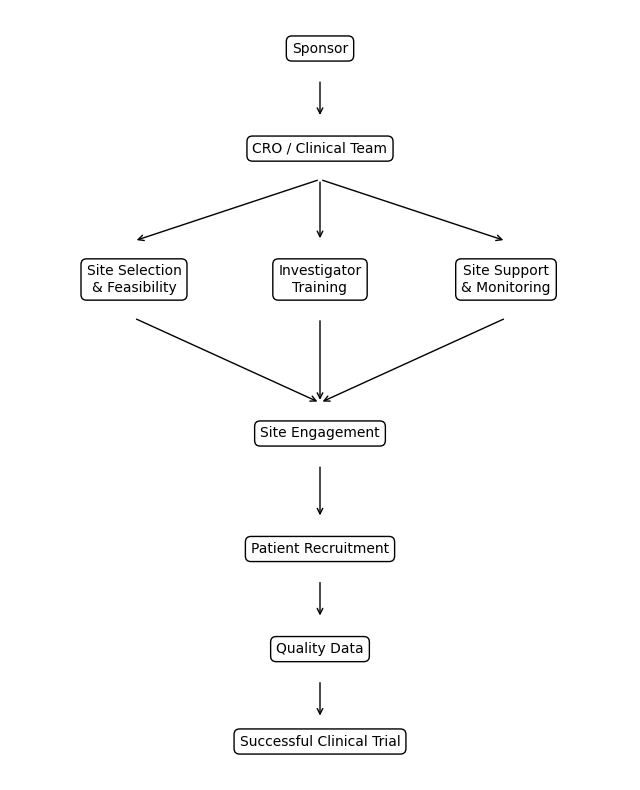
This interconnected structure highlights how effective communication between sponsors, CROs, investigators, and site teams influences every stage of trial execution, from study startup and patient recruitment to data quality and overall trial success.
How Veeda Creates High-Performing Site Networks
At Veeda Lifesciences, investigator engagement is embedded into our clinical operations strategy.
We combine scientific expertise, operational excellence, and technology-enabled solutions to create an experience that reduces site burden while improving study performance.
Our engagement model includes:
- Protocol Optimization
Designing patient-centric and site-friendly protocols by evaluating study procedures, visit schedules, eligibility criteria, and operational requirements to improve feasibility, reduce site burden, and enhance study execution. - Strategic Site Selection
Identifying investigators and sites with the right therapeutic expertise, patient access, infrastructure, and operational capabilities to maximize study success. - Continuous Communication
Maintaining transparent, proactive communication through regular updates, investigator meetings, recruitment reviews, and dedicated support channels. - Ongoing Training & Knowledge Enablement
Providing protocol-specific training, refresher programs, and digital learning solutions that help site teams remain confident and compliant throughout the trial. - Technology-Enabled Collaboration
Leveraging EDC platforms, CTMS solutions, investigator portals, remote monitoring capabilities, and analytics-driven insights to simplify operations and enhance productivity. - Recognition & Long-Term Partnership Building
Acknowledging site contributions and fostering collaborative relationships that extend beyond a single study, creating a trusted network of engaged investigators.
The Future of Investigator and Site Engagement
As clinical research continues to evolve, investigator engagement strategies are becoming more proactive, data-driven, and technology-enabled.
Emerging trends include:
- AI-supported operational workflows
- Remote and hybrid trial models
- Real-time performance analytics
- Patient-centric study designs
- Enhanced digital collaboration tools
- Reduced administrative burden through automation
These developments are expected to improve site experiences while enabling more efficient trial execution.
Conclusion
Investigator and site engagement is a fundamental component of successful clinical trial execution. Strong relationships between sponsors, CROs, investigators, and research sites contribute directly to recruitment success, protocol compliance, data quality, and overall study performance.
As clinical trials become more complex, organizations must move beyond transactional site management and embrace a collaborative partnership model that supports investigators throughout the study lifecycle.
By prioritizing communication, training, technology enablement, and long-term relationship building, the clinical research industry can create more efficient, patient-focused trials and accelerate the delivery of new therapies to patients worldwide.
At Veeda Lifesciences, this philosophy aligns closely with a commitment to supporting investigators and research sites through collaborative, quality-driven clinical research partnerships.