
Articles


Navigating Regulatory Complexity in Global Clinical Trials: How Early Regulatory Strategy Accelerates Development and Protects Program Value
As pharmaceutical and biotechnology companies increasingly pursue global drug development programs, navigating regulatory complexity has become a critical success factor.
Regulatory strategy is no longer a late-stage compliance exercise. Decisions made during preclinical development, First-in-Human (FIH) planning, and early clinical phases can significantly influence development timelines, capital efficiency, investor confidence, and the likelihood of successful global approvals.
Regulatory authorities such as the U.S. Food and Drug Administration (FDA) and the European Medicines Agency (EMA) continue to evolve their expectations around trial design, patient safety, data integrity, and compliance.
As development programs become increasingly international, sponsors must balance scientific objectives with regulatory requirements across multiple jurisdictions while maintaining operational efficiency and controlling development costs.
The Global Clinical Trials Market: Growth Driving Regulatory Complexity
The global clinical trials landscape is experiencing significant growth, creating new opportunities and new regulatory challenges for pharmaceutical and biotechnology sponsors.
According to Grand View Research, the global clinical trials market was valued at approximately USD 89.0 billion in 2025 and is projected to reach USD 158.4 billion by 2033, growing at a CAGR of 7.7% between 2026 and 2033. North America accounted for 50.7% of the global market share in 2025.
Global Clinical Trials Market Snapshot
Projected growth of the global clinical trials market from 2025 to 2033.
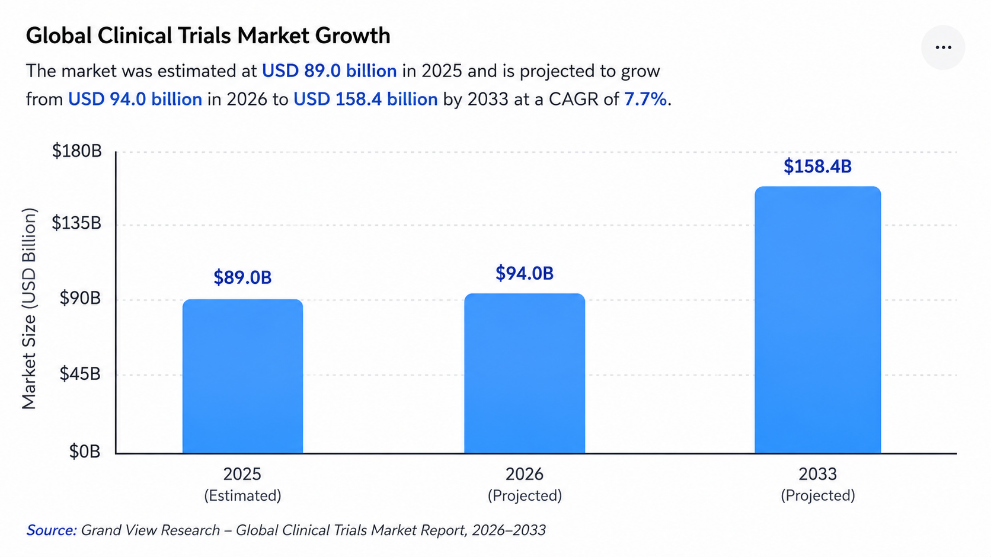
Figure 1. Global Clinical Trials Market projected to grow from USD 89.0 billion in 2025 to USD 158.4 billion by 2033, reflecting increasing investment in clinical development, precision medicine, and global trial expansion.
Reference: https://www.grandviewresearch.com/industry-analysis/global-clinical-trials-market
Growth in global clinical development is creating unprecedented competition for patients, investigative sites, specialist vendors, and regulatory attention. As a result, regulatory execution has become a source of competitive advantage. Sponsors that align development strategy with regulatory expectations early are often better positioned to reach critical value-inflection milestones, secure financing, and enter key markets ahead of competitors.
Several trends are fueling this expansion:
- Rising prevalence of chronic and rare diseases
- Growth of precision medicine and targeted therapies
- Increasing pharmaceutical and biotech R&D investments
- Expansion of decentralized clinical trials (DCTs)
- Advances in biologics, gene therapies, and cell therapies
- Growing adoption of multi-regional clinical trial strategies
These trends are increasing both the scientific and regulatory complexity of clinical development. Development programs now frequently involve advanced therapies, multiple regulatory agencies, decentralized technologies, and geographically diverse patient populations, all of which require more sophisticated planning than traditional single-region trials.
The Growing Complexity of Global Clinical Trials
Today’s clinical development environment is more interconnected and more demanding than ever before. Sponsors increasingly seek simultaneous approvals across multiple regions, requiring compliance with a patchwork of regulatory frameworks that can differ significantly in their requirements, timelines, and expectations. For organizations without large, dedicated regulatory affairs departments, this complexity represents one of the most significant risks to program continuity.
Several factors contribute to increasing complexity:
- Expanding global trial footprints
- Increasing regulatory scrutiny
- Growing adoption of decentralized clinical trials
- Complex biologics and advanced therapies
- Evolving data integrity requirements
- More stringent safety reporting obligations
The challenge is no longer simply meeting regulatory requirements in a single jurisdiction. Sponsors must increasingly design development programs capable of supporting multiple regulatory submissions simultaneously while preserving timelines, controlling costs, and generating evidence acceptable to diverse health authorities.
Programs that require major protocol amendments, additional trials, or repeated regulatory interactions frequently experience delays that extend well beyond operational timelines. In many cases, the resulting impact on development budgets, partnership opportunities, and commercialization plans can exceed the direct cost of the regulatory issue itself.
Three Regulatory Mistakes That Commonly Delay Global Development Programs
Designing development programs around a single regulatory authority: Sponsors often design protocols to satisfy the requirements of their initial target market only to discover later that additional evidence is required elsewhere. This can lead to protocol amendments, supplementary trials, and delayed global submissions.
Delaying regulatory engagement until late development: Regulatory interactions are most valuable when they influence trial design rather than validate completed work. Seeking scientific advice early can reduce uncertainty and improve alignment with agency expectations.
Treating regulatory readiness as a submission activity: Regulatory readiness should be embedded throughout development. Organizations that wait until submission preparation to address compliance, data standards, inspection readiness, or quality systems often face avoidable delays and remediation activities.
Why Regulatory Strategy Must Begin Early
Regulatory planning should begin before First-in-Human (FIH) trials rather than at the submission stage.
Early planning enables sponsors to:
- Align endpoints with regulatory expectations
- Design globally acceptable protocols
- Evaluate accelerated approval opportunities
- Reduce protocol amendments
- Prevent costly delays
- Improve submission readiness
Veeda’s Insight
Regulatory decisions made during the earliest stages of development frequently determine the efficiency of the entire clinical program. Endpoint selection, population definitions, statistical assumptions, and regulatory engagement strategies established before or during Phase I can influence submission requirements years later.
Sponsors that establish regulatory alignment early often experience fewer protocol amendments, reduced operational disruption, and more predictable development timelines. Conversely, deficiencies identified later in development are typically more expensive and time-consuming to address.
Understanding the FDA Regulatory Framework
Successful FDA interactions require more than regulatory compliance. Sponsors must demonstrate a coherent development strategy supported by appropriate nonclinical evidence, manufacturing controls, clinical data quality, and patient safety oversight.
Particular attention should be given to opportunities for expedited development programs, which can significantly accelerate regulatory interactions and review timelines when supported by robust scientific rationale.
FDA Expedited Development Programs
| Program | Key Benefit |
| Fast Track | Enhanced FDA communication |
| Breakthrough Therapy | Intensive regulatory guidance |
| Accelerated Approval | Earlier approval based on surrogate endpoints |
| Priority Review | Shortened review timelines |
While expedited pathways can shorten development and review timelines, they also require earlier strategic planning. Sponsors that evaluate eligibility only after generating substantial clinical data may miss opportunities to optimize their regulatory pathway and maximize development efficiency.
Understanding the EMA Regulatory Framework
The EMA’s Clinical Trials Regulation (EU CTR 536/2014) has transformed the European clinical trial landscape.
Key requirements include:
- Clinical Trial Authorization (CTA)
- CTIS Submission Platform
- Investigational Medicinal Product Dossier (IMPD= Documentation
- Qualified Person (QP) Certification
- Pediatric Investigation Plans (PIPs)
- EU Good Manufacturing Practice (GMP) Compliance
The implementation of the Clinical Trials Information System (CTIS) has improved harmonization across Europe but has also increased the importance of operational discipline. Submission quality, document consistency, and timely responses to regulatory questions are critical for maintaining development momentum.
FDA vs EMA: Key Differences Sponsors Must Understand
| Topic | FDA | EMA |
| Initial Submission | IND | CTA |
| Paediatric Requirement | PREA | PIP |
| Accelerated Programs | Fast Track, Breakthrough | PRIME |
| Submission Platform | ESG | CTIS |
| Data Exclusivity | 5–12 Years a | 8+2 Years b |
| Inspection Program | BIMO | GCP Inspections |
| Product Labelling | USPI | SmPC |
a Data exclusivity periods vary by product type (new chemical entity, orphan designation, biologic, paediatric extension). Sponsors should seek jurisdiction-specific guidance.
b EMA’s 8+2 year model comprises 8 years of data exclusivity plus 2 years of market protection, with potential extensions for new indications or paediatric data.
While the FDA and EMA share many common principles, differences in paediatric requirements, submission processes, labelling expectations, and lifecycle management can create significant challenges if not addressed proactively. Development strategies that account for these differences from the outset are generally more efficient than those adapted later in response to regulatory feedback.
The Critical Role of ICH Harmonization
ICH guidelines serve as the foundation for global regulatory alignment.
Key Guidelines for Sponsors
| Guideline | Focus Area |
| ICH E6(R3) | Good Clinical Practice |
| ICH E8(R1) | Clinical Study Design |
| ICH E17 | Multi-Regional Clinical Trials |
| ICH E9(R1) | Estimands & Statistical Analysis |
| ICH E11A | Paediatric Extrapolation |
| ICH M11 | Structured Protocol Templates |
ICH M11 introduces a standardized, structured format for clinical trial protocols. For sponsors designing globally submitted protocols, early adoption of the M11 template reduces inconsistency across jurisdictions and can improve the efficiency of regulatory review.
ICH E6(R3): A New Era of Clinical Trial Oversight
Finalized and progressively adopted by major regulatory authorities, ICH E6(R3) represents the most significant update to Good Clinical Practice standards in over two decades. The revised guideline emphasizes:
Risk-Based Quality Management (RBQM)
- Risk assessments
- Centralized monitoring
- Data-driven oversight
- Quality-by-design principles
Decentralized Clinical Trials
- E-Consent
- Remote monitoring
- Digital endpoints
- Direct-to-patient logistics
Data Integrity
- Audit trails
- System validation
- Electronic records compliance
- Data traceability
Implementing a robust RBQM framework requires dedicated technology infrastructure, trained personnel, and validated processes resources that are often stretched within lean development organizations. For sponsors without a large clinical operations function, the most efficient path to ICH E6(R3) compliance is to partner with a CRO that has already embedded these requirements into its trial infrastructure, allowing teams to focus on science rather than systems.
Beyond compliance, ICH E6(R3) reflects a broader shift toward proactive quality management. Regulatory authorities increasingly expect sponsors to identify, assess, and mitigate risks throughout development rather than relying solely on retrospective quality review.
Multi-Regional Clinical Trials (MRCTs): The Future of Global Development
ICH E17 provides the framework for designing clinical trials capable of supporting submissions across multiple regions.
Benefits of MRCTs
- Faster global development
- Improved operational efficiency
- Reduced duplication of trials
- Enhanced regulatory alignment
- Accelerated market access
Key Planning Considerations
- Regional representation
- Ethnic sensitivity assessments
- Statistical consistency
- Regulatory acceptability
Veeda Insight
Successful MRCTs require a balance between scientific rigor, operational excellence, and region-specific regulatory expertise. A poorly designed MRCT one that fails to account for ethnic sensitivity requirements, regional endpoint acceptability, or statistical consistency expectations can result in submissions that satisfy no single authority fully. For sponsors seeking to maximize the value of a single development program across multiple markets, getting MRCT design right from the outset is one of the highest-leverage decisions in the entire development plan.
Well-designed MRCTs can reduce development duplication and accelerate global submissions. However, the benefits are realized only when regional regulatory expectations, population characteristics, and statistical considerations are incorporated into study design from the beginning.
Common Regulatory Risks That Impact Development Timelines and Submission Readiness
| Risk | Potential Impact | Veeda’s Proactive Mitigation Strategy |
| Inadequate IND/CTA Package | Development delays and resubmission cycles | Structured pre-submission gap analysis against current FDA and EMA expectations |
| Protocol Deviations | Inspection findings and data credibility concerns | Continuous, automated risk-based monitoring with real-time deviation flagging |
| Data Integrity Issues | Submission rejection or clinical hold | CDISC-compliant data governance, validated systems, and end-to-end audit trail management |
| Delayed Safety Reporting | Regulatory actions and potential trial suspension | 24/7 global pharmacovigilance coverage with defined escalation and reporting workflows |
| Vendor Oversight Gaps | Compliance findings and inspection risk | Integrated vendor qualification, performance tracking, and transparent KPI dashboards |
| Inspection Readiness Deficiencies | Approval delays and remediation costs | Ongoing mock audits and inspection preparation embedded throughout the trial lifecycle |
Building a Regulatory-Ready Clinical Development Program
Organizations that consistently achieve efficient regulatory execution typically view readiness as a continuous process rather than a discrete milestone. The following framework helps embed regulatory discipline across the development lifecycle.
Phase 1: Pre-IND / Pre-CTA Stage (Strategy Phase)
Establish the regulatory foundation before committing significant resources to clinical execution.
- Regulatory gap assessments
- Scientific advice meetings with FDA, EMA, or other relevant authorities
- Accelerated pathway evaluations
- Global development planning and jurisdiction prioritization
Phase 2: Clinical Development (Execution Phase)
Maintain regulatory alignment throughout the trial, not just at key milestones.
- Risk-based monitoring aligned with ICH E6(R3)
- Ongoing regulatory intelligence tracking
- Protocol governance and deviation management
- Vendor oversight and performance management
Submission Preparation Stage (Submission Phase)
Ensure that data packages are submission-ready well before the target date.
- CDISC standards compliance and dataset validation
- Database readiness reviews
- Labeling strategy development
- Pre-submission meetings with regulatory agencies
How Veeda Clinical Research Supports Regulatory Excellence
Unlike traditional approaches that separate regulatory strategy from clinical execution, Veeda integrates regulatory intelligence, operational delivery, data quality, and compliance oversight throughout the development lifecycle. This integrated model helps sponsors identify and address regulatory risks before they become costly development challenges.
Our capabilities include:
- IND and CTA preparation and support
- Regulatory strategy consulting
- GCP compliance and inspection readiness
- Multi-regional trial management
- CDISC standards implementation
- Submission readiness support
- Pharmacovigilance and safety reporting
Whether you are preparing your first IND, designing your first MRCT, or managing a complex multi-jurisdiction submission, Veeda brings the regulatory intelligence and operational infrastructure to keep your program on track.
By integrating regulatory intelligence with clinical operations from day one, Veeda helps sponsors navigate complex global requirements with confidence and without the overhead of building those capabilities entirely in-house.
Conclusion
Regulatory strategy has become a defining factor in clinical development success. As development programs expand across regions, technologies, and therapeutic modalities, regulatory decisions increasingly influence timelines, costs, operational efficiency, and ultimately the commercial potential of a product.
Organizations that embed regulatory thinking early through proactive planning, modern quality systems, effective risk management, and globally aligned development strategies are better positioned to navigate complexity and achieve successful regulatory outcomes.
By combining regulatory expertise with integrated clinical execution, Veeda Clinical Research helps sponsors transform regulatory requirements from potential obstacles into strategic advantages, supporting more efficient development pathways and accelerating patient access to innovative therapies.
Ready to assess your regulatory readiness? Contact Veeda Lifesciences to speak with a regulatory expert.